

Wildlife Removal · Vaughan, ON
Skunk Removal in Vaughan, ON: Humane, Safe & Effective
Skunk under your Vaughan deck, porch or shed? Greater Wildlife Control removes skunks humanely and screens the area to prevent return visits.
Introduction
Professional skunk removal in Vaughan starts with understanding that skunks denning under your deck, shed, or front steps are a private-property issue that requires a licensed wildlife removal company-not a DIY fix. Whether you’re in Maple, Woodbridge, Kleinburg, Concord, or Thornhill, striped skunks are among the most common unwanted pests burrowing into residential structures across York Region, and professional skunk removal by Greater Wildlife Control in Vaughan is the most reliable path to resolving the problem without causing harm to the animals or your property.
The City of Vaughan does not handle nuisance wildlife on private property. Vaughan Animal Services is responsible for sick or injured wildlife on public roadways and in parks, but skunk removal from beneath residential structures falls squarely on the homeowner. That means choosing a qualified, humane wildlife removal provider who can inspect, evict, exclude, and sanitize-all while complying with Ontario regulations and Vaughan’s evolving business-licensing requirements for wildlife control services.
So how do you actually get rid of skunks in Vaughan? The most effective and humane solution is to contact a wildlife removal professional who conducts a thorough inspection, installs one-way doors to let skunks leave without re-entering, seals all access points with heavy-gauge steel mesh, and performs biohazard sanitation to eliminate lingering odour and contamination.
This guide is written for Vaughan homeowners, landlords, and property managers dealing with-or trying to prevent-skunk activity around their homes. Here’s what you’ll take away:
-
How to confirm skunk activity and distinguish it from raccoons or other wildlife
-
Why DIY eviction methods are risky, often illegal, and rarely effective
-
Exactly what humane, professional skunk removal involves, step by step
-
Typical timelines and potential skunk removal costs in Vaughan
-
Practical preventive measures that deliver long-term protection against re-entry on other structures
Understanding Skunks Around Vaughan Homes
Striped skunks (Mephitis mephitis) are among the most familiar wild animals in York Region’s suburban landscape. Vaughan’s distinctive mix of wooded ravines, stormwater ponds, greenbelts, and newer subdivisions with unfinished yards and loose backfill creates ideal habitat for skunks looking for food and shelter. Understanding skunk behaviour and seasonal nesting habits is essential before attempting any removal-missteps can trap dependent babies underground, violate provincial wildlife laws, or create far worse odour and structural damage than the original problem.
Skunk Behaviour and Seasonal Nesting Habits
Skunks are primarily nocturnal, emerging at dusk to forage for grubs, insects, small mammals, and fallen fruit. They strongly prefer ground-level den sites: the space beneath wooden decks, garden sheds, front steps, concrete slabs, and low-clearance additions. Skunks often dig beneath porches and decks, choosing locations where soft soil or poor backfill makes burrowing easy.
A typical Vaughan-area seasonal timeline helps explain why timing is critical for safe removal:
-
Late winter (February–March): Adults mate and begin seeking secure, insulated den sites for birthing. Males may travel several kilometres per night.
-
Spring (April–June): Females give birth to litters averaging 4–7 kits. Kits are born blind and deaf, completely dependent on the mother for 5–8 weeks.
-
Mid-summer (July–August): Young skunks start exploring outside the den but may still return to it nightly.
-
Fall (September–November): Skunks search for insulated winter shelter under structures, entering torpor (not true hibernation) during the colder months and emerging on warmer nights.
This cycle directly shapes removal methods. Technicians check for young skunks before sealing entries between May and July, because installing one-way doors or exclusion barriers during the nursing window risks trapping helpless kits underground-leading to decomposition, severe odour, and potential structural contamination.
Structural Vulnerabilities Skunks Target
“Structural vulnerabilities” is a term wildlife professionals use for any gap, crack, or weak spot that allows a skunk to dig or squeeze underneath a building. In Vaughan, common weak points include:
-
Open soil gaps around wooden decks, especially where grading slopes toward the house
-
Unprotected shed bases sitting directly on soil or patio stones with no perimeter seal
-
Cracked or undermined concrete front steps and porch slabs with eroded edges
-
Poorly compacted backfill around home additions, walkouts, or recently developed lots where clay fill settles over time
Skunks can cause structural damage by digging under porches, steps, and slabs. Over time, subsurface tunnelling can undermine footings, crack patio surfaces, and destabilize support piers. Skunks can cause structural damage if not removed promptly, as continued burrowing erodes the soil that supports your home’s foundation elements. Professionals look for these signs of undermining during every detailed inspection.
Knowing where skunks like to den helps homeowners recognize early warning signs-which leads directly into identifying whether you actually have a skunk problem.
Health Risks and Biohazards from Skunk Infestations
Skunks are more than a nuisance odour concern. In Ontario, they are known reservoirs for rabies and may carry leptospirosis, roundworms, fleas, and ticks-all of which pose health risks to people and pets. Raccoons are associated with diseases like rabies and leptospirosis as well, and when multiple species share den sites or yard space, exposure risk compounds.
When skunks den in enclosed spaces-crawlspaces, voids under steps, or attached garages-accumulated urine, feces, and nesting material create genuine biohazard concerns. Odour seeps into living areas through porous materials like insulation, drywall, and carpets, and can spread through HVAC ductwork. Wildlife intrusions can lead to contaminated attic spaces and crawlspace environments that require more than simple ventilation to resolve.
Professional skunk removal often includes or recommends biohazard sanitation: disinfection of contaminated surfaces, odour remediation using enzyme-based deodorizers, contamination cleanup of nesting material and droppings, and safe disposal using proper PPE (personal protective equipment). Professional cleaning is vital to remove lingering skunk musk and biological waste-eviction alone doesn’t address the health issues left behind.
How to Tell if You Have a Skunk Problem on Your Vaughan Property
Many homeowners initially confuse skunk activity with raccoons, groundhogs, or stray cats. Since raccoons are common intruders in Vaughan homes, and raccoons can cause significant property damage in homes, accurate identification is essential-it determines which removal method a wildlife professional will use.
Typical Signs of Skunks: Smell, Tracks, and Lawn Damage
The most unmistakable indicator is odour: a strong, sulphur-like spray, often noticed at night or early morning, that lingers on clothing, deck surfaces, and pet fur. Descriptions range from burnt rubber to rotten eggs, and the scent can persist for days without treatment.
Characteristic lawn damage is another telltale sign. Skunks dig small, cone-shaped holes across turf as they forage for grubs-a behaviour called “grubbing” that intensifies after rain, particularly from April through October. Other field signs include:
-
Five-toed tracks with long, visible claw marks in mud or snow
-
Droppings along fence lines or near den entrances
-
Disturbed mulch beds or overturned sod strips near structures
Finding Den Entrances Under Decks, Sheds, and Steps
If you suspect a skunk is living under a structure, observe from a safe distance using a flashlight at dusk-never crawl under a deck or shed to investigate. Skunks often dig beneath porches and decks, and active dens display specific visual indicators:
-
An oval opening roughly 10–20 cm (4–8 inches) wide with smooth, compacted soil edges
-
Fresh soil piles or “spoil heaps” pushed out around deck, shed, or step edges
-
A distinct worn pathway through grass or mulch leading to the opening
Resist the urge to block these entry points without a professional assessment. Sealing holes prematurely can trap skunks or kits underground, leading to decomposition, intense odour, and significant damage to the structure above.
When Skunk Activity Becomes an Urgent Issue
Certain situations call for immediate professional help:
-
Skunks denning against a foundation wall or supporting pier, where burrowing risks undermining the structure
-
Strong odour entering basements or main-floor rooms, suggesting a den directly beneath the living space or a deceased animal in a crawlspace void
-
Skunk spray incidents affecting pets or people, particularly repeated events indicating a nearby active den
-
Daytime sightings of disoriented or aggressive skunks, which may indicate rabies infection
If sick or injured wildlife is observed, contact Vaughan Animal Services. In cases involving bites, contact with saliva, or clearly sick animals, residents should also reach out to York Region Public Health alongside a wildlife professional. Once a skunk presence is confirmed, humane, structured removal is the safest way forward.
Humane Skunk Removal in Vaughan: What It Actually Involves
This section walks through the whole process a qualified wildlife removal services provider follows-from initial inspection through final sanitation. Humane skunk removal includes locating entry points and exclusion techniques, and it stands in sharp contrast to risky DIY tactics like trapping, poisoning, or blindly sealing holes. Skunk removal services focus on safe and humane extraction methods that comply with Ontario’s Fish and Wildlife Conservation Act and Vaughan’s local regulations.
Step 1: Comprehensive On-Site Inspection
Every professional engagement begins with a thorough inspection. A technician walks the entire property perimeter, mapping all suspected den sites, potential entry points, and structural vulnerabilities. The inspection distinguishes skunk activity from raccoons, groundhogs, or other pests by examining track patterns, digging behaviour, and odour characteristics.
In Vaughan, inspections also account for local soil conditions-clay-heavy fill, drainage patterns, and water-table depth-that influence how easily skunks can burrow and how much undermining may already have occurred. Surrounding features matter too: fence gaps, garbage bins placement, raised decks, nearby ravines, and stormwater infrastructure.
The result is a written plan outlining the removal strategy, exclusion work, sanitation needs, and estimated cost. This documented approach ensures transparency and gives homeowners a clear picture before any work begins. Wildlife removal control companies in Vaughan must hold a valid business license, and reputable providers will share their credentials upfront.
Step 2: Timing Around Kits and Breeding Season
Before installing any exclusion device, professionals determine whether a nursing female with dependent kits is present. Between May and July, this assessment is critical. Technicians listen for high-pitched vocalizations inside the den, evaluate the timing relative to the known birthing season, and look for visual cues-multiple small tracks, nursing activity patterns, or kits visible near the entrance at dusk.
When kits are confirmed, ethical companies employ “family reunification” protocols: temporary setups that allow the mother to lead her mobile young out of the den safely, without separation or starvation underground. If kits are too young to follow the mother, exclusion is delayed until they reach independence-typically by late July or August. This approach avoids causing harm to vulnerable animals while keeping the homeowner informed about revised timelines.
Step 3: One-Way Door Installation and Humane Eviction
A one-way door is a specially designed flap or mesh device installed at the primary den entrance. It allows skunks to push out and exit normally but prevents them from re-entering. This is the go-to solution for humane wildlife removal because it lets skunks leave on their own schedule, minimizing stress and spray risk.
Professional installation involves:
-
Securing the one-way door tightly to the structure to prevent bypass or pry-back
-
Monitoring the den over several nights (typically 3–7) to confirm all animals have exited, including any stragglers or juveniles
-
Avoiding baiting methods that could attract non-target species or contravene Vaughan’s Animal Control By-law
Direct relocation of skunks beyond a short distance is restricted under Ontario’s Fish and Wildlife Conservation Act. This is why exclusion-not long-distance trapping-is the standard among professional wildlife removal providers. Wildlife control services include humane animal removal precisely because the law and best practice demand it.
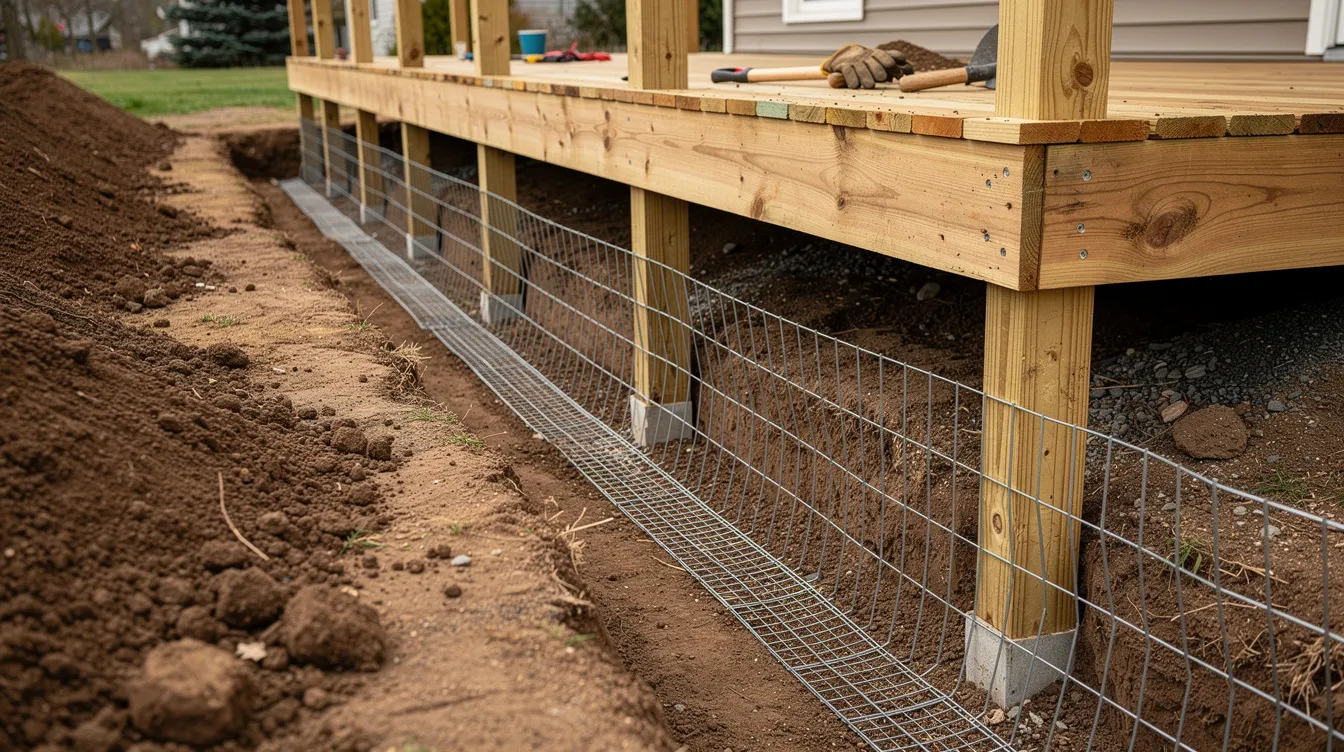
Step 4: Structural Exclusion with Hardware Cloth or Steel Mesh
Eviction without exclusion is temporary. Skunks frequently return to previously used den sites in subsequent seasons, so long-term prevention depends on sealing every access point with durable materials. To prevent skunks from returning, heavy-duty steel mesh is installed underground around vulnerable structures.
Standard exclusion work involves:
-
Excavating a trench around the perimeter of the deck, shed, porch, or steps-typically 30–45 cm deep
-
Attaching heavy-gauge galvanized steel mesh or hardware cloth to the structure’s base, extending it down into the trench
-
Bending the mesh outward in an “L” shape at the bottom of the trench to prevent re entry by digging underneath
-
Backfilling the trench and restoring grading so the finished result is clean and unobtrusive
This exclusion barrier-sometimes called skunk-proof screening or perimeter trenching-is the core of long-term protection. Quality wildlife control companies provide a written warranty on exclusion work, with coverage typically ranging from 1 to 5 years. Some Vaughan-area providers offer 2-year warranties as standard.
Step 5: Biohazard Sanitation and Odour Control
After skunks are removed, the contamination they leave behind still poses health issues. Inside or beneath structures, professionals address:
-
Removal of contaminated soil, droppings, and nesting material from accessible den areas
-
Application of hospital-grade disinfectants (chlorine or quaternary ammonium compounds) to hard surfaces
-
Treatment with enzyme-based deodorizers that break down the organic compounds responsible for persistent skunk musk
-
Safe disposal of contaminated materials using PPE, sealed containers, and proper waste-handling protocols
In more severe cases-where odour has penetrated basement walls, insulation, or HVAC ductwork-advanced odour remediation may involve ozone generators or negative-air units to purge affected spaces. Porous materials like insulation or carpet padding may need to be removed entirely.
This step completes the immediate remediation. The next section focuses on preventing skunks from returning so the whole process doesn’t need to be repeated.
Preventing Skunks from Returning: Long-Term Strategies for Vaughan Homes
Prevention is always more cost-effective than repeated removal-especially in skunk-dense neighbourhoods adjacent to ravines, greenbelts, or stormwater ponds where wild animals are abundant. Wildlife control services help prevent future animal intrusions when exclusion and attractant management are treated as ongoing commitments, not one-time fixes.
Eliminating Attractants: Food, Shelter, and Access
It is crucial to remove food attractants to discourage skunks from choosing your property over the next one. Common attractants on Vaughan properties include:
-
Unsecured garbage bins or green bins with loose-fitting lids
-
Pet food or bird seed left outside overnight
-
Compost piles or fallen fruit under trees
-
Grub-rich lawns with heavy thatch that haven’t been treated or aerated
Practical fixes:
-
Upgrade to wildlife-resistant bins and store them in a garage or shed until collection day
-
Apply grub control treatments where lawn damage is evident, or consult a lawn-care provider about integrated pest management
-
Feed pets indoors and clean up spillage under bird feeders regularly
-
Remove fallen fruit promptly and compost in enclosed bins
Securing Structures: Decks, Sheds, and Additions
Proactive exclusion during new construction or renovation is far simpler and less expensive than retrofitting after a skunk has moved in:
-
Install buried steel mesh around the perimeter during deck construction
-
Build sheds on solid concrete pads with sealed edges-no soil-to-structure gaps
-
Ensure skirting boards are tight to grade with no openings wider than 5 cm
For existing structures, retrofitting options include partial excavation and adding skunk-proof lattice backed with galvanized steel mesh. Professional wildlife companies in Vaughan can perform this as a standalone prevention package-a set of preventative measures even when no active skunk is present. This is especially valuable for commercial property owners managing multiple buildings or for landlords protecting rental units.
Landscape and Fencing Adjustments
Yard design plays an underappreciated role in reducing denning opportunities:
-
Remove brush piles, stacked lumber, and debris that provide shelter for skunks and other animals
-
Maintain tight-fitting fence bottoms or add buried mesh skirts along the fence line to prevent burrowing
-
Keep vegetation trimmed away from deck edges to improve visibility and airflow, making the area less attractive as a den site
Periodic property “wildlife audits” each fall and spring catch new vulnerabilities early-before a skunk exploits them. A seasonal inspection by a wildlife professional takes less than an hour and can save thousands in removal and repair costs down the road.
DIY vs. Skunk Removal in Vaughan
This comparison is included for balance, but the conclusion is clear: for most situations, professional, humane services are the safer, more effective, and more legally sound choice. The health risks, legal complexity, and potential for significant damage make skunk removal a poor candidate for DIY approaches.
Risks and Limits of DIY Skunk Removal
Common DIY tactics-mothballs, ammonia-soaked rags, loud radios, floodlights, homemade traps-are usually ineffective at best and potentially illegal at worst. Here’s why they fail or backfire:
-
Blocking entrances prematurely can trap skunks or kits underground. The result is decomposition under your home, intense odour permeating living spaces, and an even costlier remediation problem.
-
Working in confined spaces without training dramatically increases the chance of getting sprayed at close range or bitten.
-
Handling traps without vaccination or PPE elevates exposure to rabies and other zoonotic diseases.
-
Using prohibited trap types-body-gripping traps, leg-hold traps, or glue boards-violates Ontario regulations and can result in fines.
Under Ontario law, captured wildlife generally must be released within a short distance of the capture site. This severely limits the benefit of any DIY relocation attempt and explains why exclusion is the standard professional approach.
Squirrels can chew through electrical wiring, creating fire hazards, and raccoons can cause significant property damage in homes-so the risks of amateur wildlife removal extend well beyond skunks. Misidentifying your pest problem can lead to the wrong approach entirely.
Advantages of Hiring a Humane Skunk Removal Expert
Professional wildlife removal complies with local regulations and delivers concrete advantages that DIY cannot match:
-
Accurate species identification and assessment of seasonal factors, including whether kits are present
-
Access to professional-grade one-way doors, exclusion materials, and sanitation products not available at hardware stores
-
Knowledge of Vaughan bylaws and Ontario regulations, ensuring every step is compliant with Vaughan’s animal control framework
-
Workmanship guarantees with written warranties on exclusion barriers-and sometimes on odour control
-
Training for confined-space work, biohazard handling, and coordination with Vaughan animal control or the Ministry of Natural Resources when needed
What to Ask a Skunk Removal Company in Vaughan Before You Hire
Before hiring any wildlife removal services provider, use this checklist:
-
What humane methods do you use? (Look for one-way doors and exclusion rather than lethal control.)
-
How do you handle situations with nursing females and kits?
-
Do you provide a written estimate and detailed action plan before starting work?
-
Are you licensed, insured, and familiar with the Vaughan Animal Control By-law and Ontario wildlife laws?
-
Do you include exclusion and structural repairs, and what warranty do you offer on that work?
-
Can you handle biohazard cleanup and odour remediation if required?
Avoid companies that rely primarily on lethal trapping, offer to “relocate” animals far beyond legal distances, or refuse to provide documentation. A reputable humane wildlife removal provider will welcome these questions.
Common Skunk-Related Challenges and Practical Solutions
Many Vaughan homeowners encounter the same recurring issues. Quick, informed responses prevent small problems from escalating into major pest control situations.
Skunks Spraying Near Your Home or Pets
If a pet is sprayed, keep it outside initially-bringing it indoors spreads the odour to furniture, carpets, and HVAC systems. Avoid water-only rinses, which can spread the oily musk. Instead, use a proven de-skunking solution (hydrogen peroxide, baking soda, and dish soap) or a vet-approved skunk shampoo. Monitor pets for eye irritation, excessive tearing, or breathing difficulties, and seek veterinary care if symptoms persist.
If spray incidents happen more than once, a den is almost certainly nearby. Contact a professional to locate and address the underlying problem through safe removal and exclusion.
Persistent Skunk Odour in Basements or Living Areas
Skunk musk lingers in porous materials-insulation, carpets, drywall-and can travel through HVAC ductwork, making it seem like the entire home is affected. Immediate steps homeowners can take include increasing ventilation, running air purifiers with activated-carbon filters, and isolating the most affected areas by closing vents or doors.
When these measures aren’t enough, professional odour remediation is necessary. This may involve removing contaminated insulation, applying enzyme-based neutralizers to sub-floor cavities, or running ozone generators in sealed spaces. The longer the odour goes untreated, the deeper it penetrates building materials.
Skunks Digging Up Lawns and Garden Beds
Grubbing damage-small, cone-shaped holes peppering your lawn-is usually surface-level, but it often indicates a nearby den, especially when confined to areas adjacent to decks or sheds. An integrated approach works best:
-
Treat lawn grubs with biological or chemical controls to remove the food source
-
Install motion-activated lights as a mild deterrent for nocturnal foraging
-
Schedule a wildlife inspection to check for denning activity under nearby structures
Addressing only the lawn damage without investigating the den site is a temporary fix at best.
Skunks Under Front Steps or Structural Slabs
When skunks burrow under poured-concrete steps, porches, or garage slabs, the risk of undermining and cracking is significant. Skunks can dig beneath structures, causing structural damage that may require masonry or foundation repair after the animals are removed. Avoid DIY excavation next to foundations-incorrect digging can create additional voids and worsen the problem.
A professional assessment may involve coordinated work between the wildlife removal company and a masonry or foundation contractor to ensure both the wildlife issue and structural integrity are addressed properly.
Conclusion and Next Steps for Vaughan Homeowners
Skunks in Vaughan are a common but entirely manageable problem when addressed promptly with humane, professional methods that combine eviction, exclusion, and sanitation. The key is acting early-before burrowing causes structural damage, before odour saturates your home, and before the birthing season limits your options.
If you suspect skunk activity on your property, follow these steps:
-
Safely document signs (photos of damage, den openings, tracks) without approaching or cornering the skunk.
-
Avoid blocking holes or setting traps until a professional assessment confirms the scope and timing.
-
Contact a humane skunk removal specialist in Vaughan for an inspection and written plan.
-
Implement recommended exclusion and preventive measures as soon as the work is complete to prevent re-entry.
Related topics Vaughan homeowners often explore next include raccoon removal from attics and soffits, squirrel removal and squirrel control for roof-level intrusions, bat removal from wall cavities, and broader wildlife-proofing strategies for both residential and commercial buildings.
Additional Resources for Skunk Removal and Wildlife Help in Vaughan
-
Vaughan Animal Services: Contact for sick or injured wildlife in public spaces, roadways, or parks. They also enforce the city’s Animal Control By-law and can direct residents to authorized wildlife rehabilitators. Vaughan animal control does not handle nuisance wildlife on private property-that requires a private wildlife removal company.
-
Ontario Ministry of Natural Resources and Forestry: Provides provincial rules on wildlife removal, legal trap types, and relocation distances under the Fish and Wildlife Conservation Act.
-
York Region Public Health: Offers guidance on rabies exposure protocols, including what to do after potential contact with a skunk or other wildlife.
-
Seasonal wildlife-proofing checklists: Many humane wildlife removal providers offer spring and fall inspection services that identify new vulnerabilities before animals exploit them-a cost-effective form of long-term prevention.
The distinction matters: call a private wildlife control company for skunks denning on your property, and call Vaughan Animal Services for injured wildlife, road hazards, or aggressive behaviour in public areas.
FAQ: Skunk Removal in Vaughan
How much does professional skunk removal cost in Vaughan, and what factors affect pricing? Potential skunk removal costs range from CAD 500 to CAD 1,000 in Vaughan, depending on the number of den entrances, extent of exclusion work required, structural complexity, and whether odour remediation or baby skunk handling is involved. Multiple access points, masonry repairs, or emergency spray-response calls increase the total. Reputable companies provide a written estimate after a detailed inspection.
How long does it usually take to remove skunks from under a deck or shed? From the initial inspection through confirmed eviction and exclusion, the process typically spans 5–10 days. One-way doors are monitored for several nights to ensure all animals have exited. If structural reinforcement or concrete repairs are needed, add several additional days. During birthing season, timelines may extend to late summer to protect dependent kits.
Is it legal to trap and relocate skunks myself in Ontario? Ontario’s Fish and Wildlife Conservation Act restricts the use of many trap types and limits how far captured wildlife can be relocated. Killing, relocating beyond permitted distances, or using body-gripping, leg-hold, or glue traps without authorization can result in fines. Professional wildlife removal complies with local regulations and provincial law-DIY trapping rarely does.
Will humane one-way doors harm the skunks or separate mothers from babies? When installed correctly and at the right time of year, one-way doors do not harm skunks. Professionals avoid installing them during the critical nursing period (May through July) to ensure mothers are not separated from dependent kits. Family reunification protocols allow the mother to lead mobile young out safely before exclusion is finalized.
What time of year is best for skunk exclusion work? Late summer through early fall-August to September-is ideal. By this time, kits are independent and mobile, and the weather still allows excavation and mesh installation. Spring exclusion risks trapping nursing females and kits; winter exclusion can deny skunks essential shelter during the colder months when they enter torpor.
What can I do tonight if I smell skunk spray in my house? Open windows and run exhaust fans to ventilate. Turn off HVAC systems temporarily to prevent the odour from spreading through ductwork. Place bowls of white vinegar or activated charcoal in affected rooms to absorb some odour. These are temporary measures-if the smell persists or returns, contact a wildlife professional to locate and address the source den.
Are humane skunk removal methods safe for children, pets, and gardens? Yes. One-way doors and exclusion barriers are passive, non-toxic systems. No poisons or harmful chemicals are used. Professionals secure all devices to prevent tampering by children or pets. Garden areas are not affected beyond the immediate trench zone where mesh is installed, and grading is restored after the work is complete.
Should I call a pest control service or a wildlife removal company? For skunks and other wildlife like raccoons, squirrels, or birds nesting in structures, a specialized wildlife removal company with local expertise in humane methods is the appropriate choice. General pest control services typically handle insects and rodents. For wildlife intrusions-including bird removal, chipmunk removal, or opossum removal-look for a provider licensed under Vaughan’s wildlife removal framework who offers both removal and exclusion as part of their control services.
Get a free quote
Book Skunk Removal in Vaughan
Need skunk removal in Vaughan, ON? Share a few details and a local, experienced technician will call you back — usually the same day.
Your contact details
We'll use this to call you back.